Monday, April 7, 2014
Standing Out and Staying Relevant in the Growing Digital Crowd!
Wednesday, September 25, 2013
The File Sharing Dilemma (a.k.a. It's 3am do you know where your content is?)
To help put the changing landscape in perspective, here are some results I've pulled together from a few surveys:
- 65% of respondents have accessed work-related data on their mobile device, though only 10% have corporate-issued devices. Shockingly, over 50% said access to their devices wasn't password protected.
- 78% of companies say the number of personal devices connecting to their networks has doubled over the past two years. However, less than 10% are fully aware of which devices are logging in.
- 93% of companies without an enterprise file sync and share platform say their employees are specifically using Dropbox, despite (or, more likely, unaware of) several recently documented security issues.
Monday, May 6, 2013
Productive or time wasting - When can we stop asking this question?
“….the notion of working 9-5 from an office is being replaced by the idea of being able to “connect to work;” an employee feeling like a cog is being replaced by the voice of the engaged employee; email and intranets are being replaced by networked and connected systems; yearly reviews are being replaced by real-time feedback; working in silos is being replaced by cross-boundary collaboration, and the traditional idea of what it means to be an organization is being replaced by evolving to a collaborative organization.”
Sunday, February 17, 2013
Turning 40 and Paying it Forward
It did not take me long to realize that doing 40 good deeds was a very lofty goal and not something I could get through in one day. But this exercise really did have an effect on me and I am going to make a bigger effort to pay it forward more often.
Here is the list of things that I did manage to accomplish:
Good Deed One:
Took my husband out for lunch!
Good Deed Two:
Donated toys to St. Vincent
Good Deed Three:
Made the choice to donate my Airmiles to the human society for the rest of the month
You can do this too by printing off this card Airmiles for the Humane Society
Good Deed Four:
Brought a pot a chili to a neighbor
Good Deed Five:
Purchased 3 Starbucks gift cards and hid them inside 3 books at my public library.
This one gave me the most pleasure. I may make this a regular practice. I tried to pick books that I thought would be read by people in most need of an act of kindness.
Good Deed Six:
Bought flowers for a friend
This exercise was so rewarding and I have vowed to make this an annual effort on my birthday. Pay it Forward Birthday I am also going to try and involve my family in the effort. On the official "Pay it Forward" day on April 25th I will be including my kids in the experience in hopes that they can gain a better appreciation of what it means to give and not always get.
My hopes in sharing my experience via a blog post is that I will inspire others to get involved in the "Pay it Forward" movement.( Pay it Forward Site) I think we can all agree that the world today can always use a few more random acts of kindness!
Wednesday, January 30, 2013
Could the Junk Drawer 1.0 Become the Junk Drawer 2.0?
![]() |
| Yes, this is my real junk drawer! |
Ah, the infamous junk drawer. We all have them in our homes. They are that designated place, often a kitchen drawer, where we store the items that we use frequently that really don’t have a proper home, or they do but never make it back there. In the drawer, there is a huge quantity of “stuff” that we need, not all of it put there by us.
Typically the junk drawer creation is a group effort, with many contributors in the home. There are a lot of items in there that I have several of, like 4 sets of spare keys, 6 nail files, chopsticks, 15 pens, all different colors of course. I often need dig to the back of the drawer to find what I need, and by the time I get to it I realize that I don’t need it anymore as I now need to move onto a different task in the house.
My last trip to the junk drawer gave me a sense of déjà vu as I realized that is a similar experience that I have when I am trying to locate information in the office. As I launch my PC and try to search for a piece of content that I need to work I open my intranet and realize that there is a ton of content here, created and added by several different people. The content is often contributed by a large number of authors, and often there can be duplicated work, appearing in a variety of formats and layouts. Even with the best search tools, there is no easy way to find the information that you need without looking through many different layers that often exist inside the intranet. Often before I locate the content I am looking for, I am pulled into another direction, probably an urgent email that needs to be dealt with. According to IDC, “The typical enterprise with 1,000 knowledge workers wastes $6 million to $12 million per year searching for non-existent information.”
Of course my junk drawer at home is small in size and can be easily cleaned out and reorganized to be effective again. The same cannot be said about the intranet or file shares that many of us are using. As the amount of content grows, so does the size of the junk drawer.
So how can we battle this plague of the ever expanding junk drawer? Content is not going to stop growing. According to Yankee Group, “80% of data in an enterprise is unstructured Information. This type of information is growing at 200% per year.” Many companies are tackling this issue by moving away from the static intranet scenarios and adopting a better, more effective way to work by deploying more collaborative tools that augment their content with social features. Allowing them to share more effectively with co-workers, add value to the existing content and search more easily for both content and the people they need to be able to get their work done. But are team spaces, social collaboration tools and community spaces exempt from the plague of the junk drawer. I don’t believe so. It is just as important to ensure that these environments are also designed with purpose and driven by good design.
I am seeing this first hand as OpenText has adopted the use of our Tempo Social application internally. Our new environment has quickly spawned well over 300 communities in a short time frame. We are learning firsthand the importance of keeping the signal to noise ratio just right to encourage adoption. We are thinking through things such as the lifecycle management required for communities. We are learning how to better understand when a community is needed versus a forum or a project space. We recently hosted a webinar session campaigns.opentext.com/forms/2013-Q3-GL-CS-OS-OTLive-January172013 on the topic that resulted in some great conversations, in case you are interested. We have also published our use case for using Tempo Social.www.opentext.com/2/global/customers-home/successstories.
I would love to hear from others on what their recipe is in avoiding the “social sprawl” that can result in the junk drawer 2.0. Feedback and comments appreciated!
Friday, July 13, 2012
Working out Loud: No More Knowledge Hoarding!
Monday, April 2, 2012
Web Personalization, Online Privacy and the Fine Line Between Convenience and Creepy…
I think most would agree that there is something comforting about walking into your favorite coffee shop and having the barista start on your drink order before you even ask. It makes you feel a little more important, it makes you feel as though the shop cares - but does this comfort translate to an online experience?
Am I comforted by the fact that Google and or Amazon is presenting me with content before I search for it? Content that is targeted at me based on things like; my location, my time of day, my gender, my browsing habits, my buying habits, my email, my social networking habits?
While I agree with what is stated below:
Without personalization, the Web is a 'static' environment where every user is presented with the same content and users will select which content to view based on navigation and search results. As a result without personalization Web Experience Management is predominantly a low engagement 'pull' relationship that a user has with content. Personalization changes this relationship into an environment where the web assists the user in their voyage of discovery by pushing content to the forefront in a manner that is specific to their 'journey' or interest. In this way the web content is deemed to be managed and the content provided in context to the user.I do wonder at what point does this become too much, or too close for comfort? Are the right safeguards in place to protect the privacy of the consumer? When do things like targeting, segmenting and personalization become more creepy than convenient?
Mobile devices have the ability to take this even a step further by making use of our location information to learn more about us, and we can already see examples of this happening today. Look at tools like Foursquare that allow consumers the ability to publish their every move and then reward them with store coupons as a result of sharing this information. (I actually use this feature and find it quite rewarding but there can be a dark side to this, as you can see in this article.)
Will we get to a point where we try to hide our digital footprint or will it just become a fact of life that we learn to accept?
Now of course the above is written in the view point of my consumer life, but in my work life, I certainly welcome targeting, segmenting and personalization. In this context, the more personalization the better! If my intranet can better understand my needs by doing the following; tracking my content browsing habits; matching my profile to others based on similar areas of expertise; understanding the context of the content I am searching for; and then use this data to deliver more targeted content to me to help me do my work more efficiently - then bring it on! My next post will write more about this side of things so stay tuned…
Friday, December 23, 2011
Tis' the Season for Sharing: My Top 10 Sites for 2011
Thursday, December 22, 2011
The Importance of Measuring Social Business to Fuel the Customer Experience
Social business is about connecting users, partners and customers through purposeful conversation and collaboration and most importantly; it’s about integrating or weaving social media into our existing business functions to help build a more collaborative infrastructure.
Social Business Driving Engagement
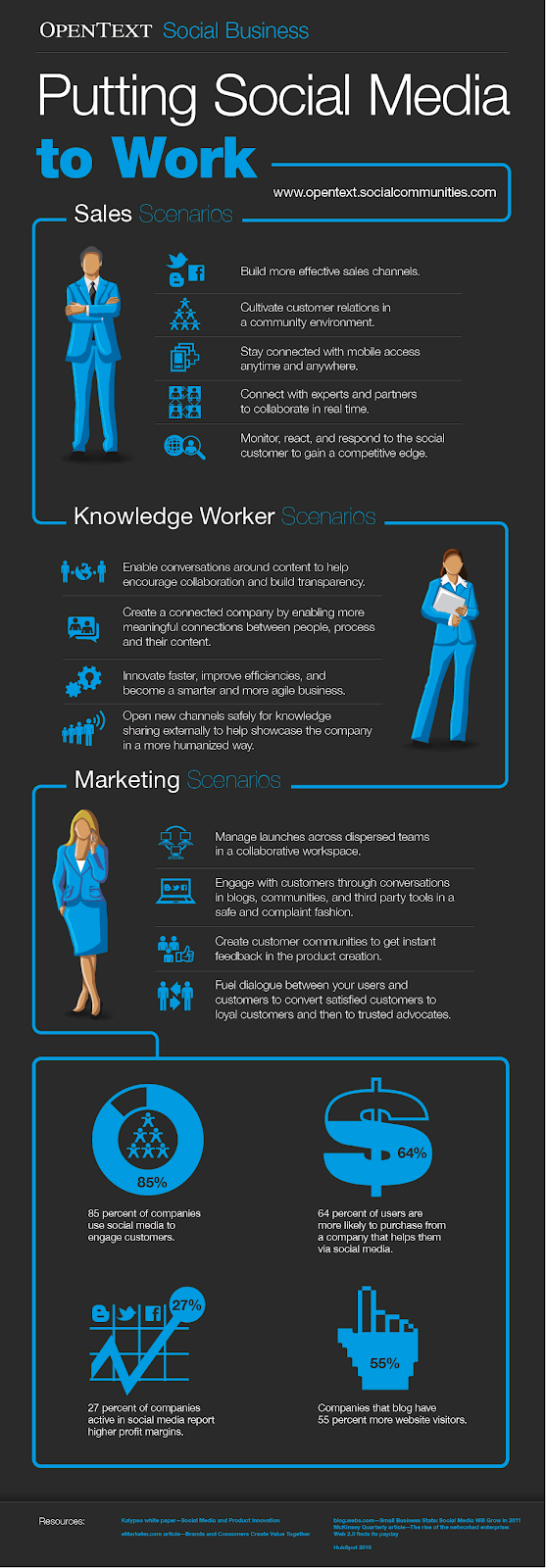
While often hard to measure, social business has productivity impacts that can be felt by IT, Sales, HR and many other areas in the organization — see Infographic (reg required) — but the real impact, and where the ROI can be best shown, is the increased engagement your internal and external audiences have with the communications initiatives that you invest in.
The key to measuring this increased engagement is ensuring you have the right tools and strategies in place to help monitor, react and respond to these initiatives in real time.
By analyzing real-time visitor and social interaction information (both inside and outside the firewall), organizations can help to optimize online initiatives and identify actionable trends within their visitor base, and capture user events that are specific to business goals.
The Impact of Social Analytics
The power in using Social Analytics is enabling the business to use the data to make recommendations to the business about how things are working, or not, and how they can be improved upon, both for your users and your customers.
Social analytics, from an external view, provides a window into things like how people perceive your brand and how they are responding to your corporate products, services, and marketing messages.
Internally, social analytics provides a window into things like; what is the most engaging content on my intranet; how many people are commenting on our blogs; what the tone of those comments are and who the most influential people in my community are.
Social Analytics can become the vehicle that helps your business translate data into insights. It can help improve your customer experience by writing better targeted content, can provide sentiment analysis, create higher converting sites and reshape a user’s site navigation to improve the overall online experience — just to name a few!
Wednesday, November 23, 2011
The Path to Social Business..Share, Engage and Measure

I spent the last week fully immersed at our user conference (OpenText Content World 2011) and in my opinion; I think it may have been our best conference to date. Each year I like to create a post after the conference that speaks to my experiences at the event and this year I thought it would be interesting to take a look back at a previous post I wrote in 2009 on social media and it's use and acceptance at the conference, just to see how far we have come in the last 2 years. As with the past years, I went to the conference to present on the topic of social business and the value of applying social media across the organization to help improve the customer experience. In 2009 I wrote in my post;
There was a general consensus with the attendees in my sessions that it was not a question of whether or not they saw the need to introduce more “social” tools to their users to allow them to contribute and build out conversations around content and business processes - the struggle existed in the ability to shift the mindset of users. Many people in the room were more concerned about how they were going to be able to adapt to the use of social media. They understood that this was more than just introducing new tool sets; it represented a culture shift - a shift that needs to happen to make the use of these social tools take on meaning and relevancy in their organizations.
It was nice to see this progression in the conversation around social media. The conversation is no longer just about the "why social media", we have progressed to the "how social media" and now we are starting to hear "how can we do better social media".
Where are you in your path to social business? Let's keep the conversations moving....
Monday, October 17, 2011
Social Buiness: It's Time to Put Social Media to Work!
Over time, we are seeing many great use cases of value add when we apply the use of social features in the context of a existing business process; such as the on-boarding of new employees by offering them more transparency to the companies goals; empowering sales teams with collaborative team spaces to better learn from each other; fueling conversations with customers for improved marketing effectiveness, and many others.
My advice is start small, think about an area of your business that could benefit from increased levels of engagement. "Situating social media in high intensity areas of worker engagement and putting it in the flow of work is much more likely to result in substantial return on investment than large, horizontal deployments." wrote ZDNet's Dion Hinchcliffe.
Monday, July 25, 2011
Social Media and Rock and Roll...Building a Better Experience
Summer time means for me a slew of outdoor concerts. So far I have been to at least 7 live shows over the course of July. Something that I have noticed at these live shows is the growing use of social media on mobile devices. A number of the shows have had large flat screens along each sides of the stage running live Twitter stream feeds and Facebook updates with their event hash tags. These streams were representing fans trying to engage with both the performers and the audience. I saw several shout-outs for birthday wishes, requests for reactions such as “let’s all scream when this hits the screen”, (no one ever screamed though) and even a marriage proposal (did not see an acceptance tweet). Apart from what I would call “spam like” tweets and status updates, I also saw a lot of interesting conversations happening between the fans and the bands themselves performing on stage. This to me is where we can truly see a shift in the music culture happening, much like what we are seeing in the shift to social business in the Enterprise world. The wall between rock star and fan is slowly coming down with the use of social media. This was duly noted in a blog post I read this weekend here.
"As music blogger Bob Lefsetz pointed out that historically in music there has been a buffer between star and audience, but thanks to social networking sites the barriers were coming down. "It was like everybody with a media profile had a coach. And if you disobeyed him, you were booted from the team," he wrote. "But now, through the magic of the web, through the magic of Twitter, a celebrity can speak directly to his audience; can tell his side of the story, sans the reinterpretation and the agenda of the media."
More and more, artists are starting to see the power of building stronger connections with their fan base and the power behind giving the fans what they want. They are going beyond just the top down fan club approach and creating that VIP customer experience by building conversations with their fans through tools like Twitter and Facebook. They are harnessing that power to turn that experience into a more engaged fan base; which can turn into a larger fan base and at the end of the day, can also become a vehicle for selling more media(songs, CD’s, t-shirts). The beauty of this is that this is all happening organically and without the help of the big record labels themselves.
What I find of interest here is that social media is leading the music industry into a new business model, one that is driven by being more social and more open. We are already seeing this happen in the business world as we drive more social collaboration into our business process, but it is nice to also see this happening across a broader perspective and driving change in other areas as well.
Where else are you seeing this happening? Let’s socialize our thoughts….
Friday, June 10, 2011
Is What I had for Lunch on Thursday a Corporate Record?
Today more and more companies are asking their employees to get out there and start swimming in the streams of social media. Companies are asking their employers to take part in social media forums such as blogs, Twitter, Facebook, YouTube and LinkedIn to help build better connections with both their peers and customers. Here are just a few of the questions that typically follow after hearing this request:
What am I suppose to talk about?
Do I only talk about the company?
Do I need to create a new account that is separate from my existing personal account?
Can I still Tweet about what I am having for lunch? (OK, maybe not..but had to throw it in there)
These are all great questions and the answers should be captured by your corporate social media policies.
Social Media creates new and exciting opportunities for an organization such as increased engagement with employees and new channels of conversation with customers; but it can also create equivalent risks and obligations. The key is to capture this balance between risk and reward.
Before a company embarks on having their employees dive into these social media streams it is crucial that your employees clearly understand the risks and how they can help mitigate them. Employee education and awareness on social media policies are a must.
I wanted to share with you an excerpt from an article I read recently titled; From 'friend request' to discovery request: Issues raised by business use of social media. This was written by Matthew A. Cordell and Barry P. Harris, IV, Ward and Smith, P.A. The full article can be found here.
“In creating social media policies, businesses must understand what can be implemented and enforced; the policies will form a baseline in an opponent's or court's analysis of what can or should be produced in discovery.”
“Social media can open new doors, but it also presents new challenges. All businesses participating in social media should adopt and implement policies governing its use by employees, and must be prepared to preserve relevant social media data as soon as it becomes reasonably apparent that litigation or an investigation is on the horizon.”
So my advice is to dive in, for the rewards will quickly outweigh the risks!
Wednesday, May 25, 2011
It's (Already) Time to Rethink Social Media
Here are a few excerpts from the article and I hope you will go and have a read of the article in its entirety on their website. (http://www.kmworld.com/Articles/White-Paper/Article/Its-(Already)-Time-to-Rethink-Social-Media-75435.aspx)
Or if you are not a KM World member you can obtain a copy from the OpenText website here.
“Even though most organizations have been using social media tools for some aspect of their business for two to three years, most say that a steep learning curve has yet to be overcome where understanding and effectively using it is concerned. Worse, a woefully low segment indicates that they are doing it well in terms of leveraging multiple social media channels to achieve specific business objectives.”
“Not only is social media about establishing meaningful conversations (not just communications) with customers, it is about improving response levels and the quality of the overall customer experience. Achieving this takes more than just tools and techniques. It takes a real commitment from the organization and participation at all levels. The trouble is that many organizations have policies that preclude participation from staff that are actually best suited to respond to customers. Still, more than 45% of large organizations block staff use of public social media tools. In certain sectors, such as investment advisory firms in financial services, it is actually illegal for certain departments to communicate with other departments using messaging or any other social media tool.”
“By delivering enterprise-class social media applications that can extend to customer use cases for the Web, intranet and extranet scenarios, such as a social platform from OpenText, organizations can rapidly apply social media to existing team collaboration and content and knowledge management solutions to capitalize on the opportunities of social media while averting the risks it may pose.”
Thanks for reading and I look forward to the conversations!
Monday, February 14, 2011
Join me at the Virtual Enterprise 2.0 Conference: Let's get Back to Business! Social Media Applied to Core Business Objectives...

The event is on Wednesday the 16th of Feb from 12 to 5pm est. and it’s free to attend. I will be joined by a number of other great speakers so I hope you register and join the conversation!
You can take a look at the agenda and register here: http://www.e2conf.com/virtual/agenda/
Friday, December 17, 2010
Monitor, React and Respond: Are you listening?
Monday, September 20, 2010
Engagement in the Enterprise
It is a very busy time at Open Text as we get ready to launch the ECM Suite 2010. My involvement in this launch is working on the Engagement products. I have had several conversations over the last few weeks on what engagement and an engaged work force means and I was quite surprised to read the statistics that speak to the current level of engagement in the workforce.
According to the Gallup Management Journal’s Employee Engagement Index survey, in a typical workplace:
• 29% of employees are actively motivated and engaged in their jobs
• 71% are unmotivated and dis-engaged
• 54% are not engaged at all
• 17% are actively dis-engaged
In fact, The Towers-Perrin Global Workforce Study (http://www.towersperrin.com/tp/showhtml.jsp?url=global/publications/gws/key-findings_2.htm&country=global) found that engagement has reached what many would call a crisis level encompassing over 70 percent of the workforce and over 50 percent of management.
Many of the factors that are contributing to the dis-engaged work force include economic downturn, downsizing, information overload and a global work force. A dis-engaged workforce does not just mean unhappy employees; it can have much larger ramifications.
According to a recent study by the Gallup group; “actively dis-engaged employees — the least productive — cost the American economy up to $350 billion per year in lost productivity.”
Helping employees to efficiently manage information overload is one vital step to building a more engaged workforce. Providing knowledge workers with a platform that allows for knowledge sharing and collaboration is not a new idea; corporate intranets have offered this premise for years. But the paradigm shift we are seeing on the web, in how we communicate and interact with each other in the consumer world, is quickly making its way into the enterprise. We need to consider this shift as we revisit our corporate intranet platforms and ask ourselves, how effective is this platform and how can I make it better? What lessons can I take away from social media tools such as Twitter and Facebook?
A few key things to ask of your intranet: Does my intranet give my knowledge workers the ability to;
Make their voices heard,
Share their expertise with others,
Gain recognition and build reputation,
Connect with each other in real time.
If you answered no to any of the above, maybe it is time to look at refreshing your intranet platform to help better unify your workforce. I would recommend that you learn more about how you can apply social media such as blogs, wikis, comments, ratings and microblogging to your current intranet to help encourage a more collaborative, productive and engaged workforce.
If you have any examples of success stories in building out a more engaging social intranet I would love to hear them!
Tuesday, June 1, 2010
Call me, email me, text me, ping me, follow me, SMS me, BBM me...too many options?

867-5309 - great song and a sign of the times in the early 80’s, one number, one way to reach someone. What would the song be like today? PIN5309, @8675309, 867@309.com, the list goes on.
When I heard this song, I began to think back to when I first started in my role as an inside sales rep in the late 90’s. My three choices of communication in the office were, in person, on the phone and email. Email was still new at the time and I can remember debating whether or not I wanted to have my email on my business card. It seems so strange now. Back then, I was not convinced that anyone would actually try to reach me this way. Little did I know that 10 years later I would be battling with it every day in a game of catch-up.
When I take inventory of how many tools and methods I have at my disposal today (thanks to the Internet and social media) to communicate with my peers and friends, I start to see the evolution of communication and the speed in which things are changing. Today when I need to reach out to a co-worker I can do the following; Walk over to their cube, but that doesn’t happen very often as most of my colleagues are in other countries. I can send an email, but that tends to get lost in a black hole. I can pick up the phone, but many of my co-workers have gotten rid of their desk phones. I can call their mobile device and that is usually a good bet as most people are always on these days. Or, if I know they are in a meeting then I will IM them on my corporate IM tool, Real Time. If that does not work maybe I will try their BBM, if that does not work maybe I can...and it goes on and on.
You would think that by having all of these different forms of communication my productivity rate would be off the charts, but that doesn’t seem to be the case. Both the glut of email and the disruptions in IM, that take me away from my tasks, start to detract from my ability to get my day to day work done. What I need is a communication tool that can provide me with more focus. It is not by coincidence that we are now seeing a trend in the Enterprise that has more users making use of tools such as Yammer. Gartner recently predicted that by 2012, activity streams (microblogging) will be used by over 50 percent of Enterprises.
I have found that making use of a microblogging tool such as Yammer and my Enterprise tool, Open Text Pulse (yes that’s a shameless plug); in conjunction with tools such as email and IM is a leap forward over just email on its own. These tools allow me to broadcast a message or a question to many, share my status and location as well as see status updates of new content being created in my Enterprise by co-workers that I follow. That is not to say that I think the victory of one is not a peril to the other. I think email will always have its place but in my experience, microblogging does a better job at delivering a comprehensive view into my knowledge base. Microblogging can augment the Enterprise by allowing employees to update each other on projects they’re working on and provide shared support and guidance.
Would love to hear your thoughts and or experience on the subject?
Monday, March 29, 2010
Open Text is Everywhere, even at the CTIA 2010 Wireless Conference
In keeping with the theme of mobility, I had the opportunity to attend the CTIA 2010 Wireless conference last week in Las Vegas with my employer Open Text. We were there to talk about our latest offering, Open Text Everywhere. We were showcasing our offering in RIM's Blackberry booth as a RIM partner. It was a great conference and I was able to see a lot of exciting new things in this space. While the conference was very consumer focused ,there was definitely a lot of talk in the keynotes and sessions about how mobility in the Enterprise space will help revolutionize the way we work.
I took some time out from the expo floor to interview our Mobility Product Manager, Rohit Gupta, to obtain some more details around our new offering and our mobile strategy.
Tuesday, March 23, 2010
The Reflex: Mobile and Me