Wednesday, January 30, 2013

Could the Junk Drawer 1.0 Become the Junk Drawer 2.0?

Yes, this is my real junk drawer!

Ah, the infamous junk drawer. We all have them in our homes. They are that designated place, often a kitchen drawer, where we store the items that we use frequently that really don’t have a proper home, or they do but never make it back there. In the drawer, there is a huge quantity of “stuff” that we need, not all of it put there by us. 

Typically the junk drawer creation is a group effort, with many contributors in the home. There are a lot of items in there that I have several of, like 4 sets of spare keys, 6 nail files, chopsticks, 15 pens, all different colors of course. I often need dig to the back of the drawer to find what I need, and by the time I get to it I realize that I don’t need it anymore as I now need to move onto a different task in the house.

My last trip to the junk drawer gave me a sense of déjà vu as I realized that is a similar experience that I have when I am trying to locate information in the office. As I launch my PC and try to search for a piece of content that I need to work I open my intranet and realize that there is a ton of content here, created and added by several different people. The content is often contributed by a large number of authors, and often there can be duplicated work, appearing in a variety of formats and layouts. Even with the best search tools, there is no easy way to find the information that you need without looking through many different layers that often exist inside the intranet. Often before I locate the content I am looking for, I am pulled into another direction, probably an urgent email that needs to be dealt with. According to IDC, “The typical enterprise with 1,000 knowledge workers wastes $6 million to $12 million per year searching for non-existent information.”

Of course my junk drawer at home is small in size and can be easily cleaned out and reorganized to be effective again. The same cannot be said about the intranet or file shares that many of us are using. As the amount of content grows, so does the size of the junk drawer.

So how can we battle this plague of the ever expanding junk drawer? Content is not going to stop growing. According to Yankee Group, “80% of data in an enterprise is unstructured Information. This type of information is growing at 200% per year.” Many companies are tackling this issue by moving away from the static intranet scenarios and adopting a better, more effective way to work by deploying more collaborative tools that augment their content with social features. Allowing them to share more effectively with co-workers, add value to the existing content and search more easily for both content and the people they need to be able to get their work done. But are team spaces, social collaboration tools and community spaces exempt from the plague of the junk drawer. I don’t believe so. It is just as important to ensure that these environments are also designed with purpose and driven by good design.

I am seeing this first hand as OpenText has adopted the use of our Tempo Social application internally. Our new environment has quickly spawned well over 300 communities in a short time frame. We are learning firsthand the importance of keeping the signal to noise ratio just right to encourage adoption. We are thinking through things such as the lifecycle management required for communities. We are learning how to better understand when a community is needed versus a forum or a project space. We recently hosted a webinar session campaigns.opentext.com/forms/2013-Q3-GL-CS-OS-OTLive-January172013 on the topic that resulted in some great conversations, in case you are interested. We have also published our use case for using Tempo Social.www.opentext.com/2/global/customers-home/successstories.


I would love to hear from others on what their recipe is in avoiding the “social sprawl” that can result in the junk drawer 2.0. Feedback and comments appreciated!

Friday, July 13, 2012

Working out Loud: No More Knowledge Hoarding!

I spend much of my work day as many do, writing documents, sending emails and researching online. A typical document that I write goes through several reviews, and I am often leery to send a draft for review until I am almost 70% sure of the content that I have laid out.  Through my editing process I often come across some great nuggets of information and the old me use to say, keep that in your back pocket to use when needed. 

Yes, I was “knowledge hoarding”.

The term knowledge hoarder is often heard in business as knowledge holds great value. I know more than you, so I hold the power. Knowledge hoarding is often seen as a method of ensuring job security. Employees often feel that the company could not do without them simply because they can’t do without the knowledge they hold inside their heads. As a result, a lot of content is sealed away on home computers, locked down in file stores and databases and kept in silos for no one else to see. This culture is starting to back fire and I like to think that Social Business has something to do with this. The power of “working out loud” sharing those drafts, crowd sourcing ideas and connecting with others both internally and externally to build conversations around content is proving to have significant power that will see a shift in culture to help fuel a more transparent and open work environment.

Collaborating on content is not new; we have had the ability to do this for years. We all send documents through emails, create wikis together, post documents in team spaces, but what is new is the ease and the velocity in how it can happen when powered by the right tools designed with the right strategies. Now, when I embark on writing a new piece of marketing content or get engaged in a new project I look to my network first to see, who can help, who can contribute and who has had success in this area in the past that I can learn from.

Simply sharing what you are working on as you are getting started, maybe in an activity stream or on Twitter or Facebook or by posting an idea to your ideation app  - all of sudden you are opening a window of opportunity and inviting others to share their thoughts and or ideas. All of sudden you have 10 or more  experts at your fingertips helping you to pull together your research and your project suddenly has wings and you are completing your work in half the time and with a renewed perspective (that may be a bit of an exaggeration, but the possibility is there). Imagine if I could write a marketing piece for a new product based on feedback I am getting directly from a beta customer. I am guaranteed that this piece will now have more meaning since I am more aware of the audience. Of course this sounds easier said than done and much of the concept of “working out loud” comes with change and we all know that change is hard. Removing the knowledge hoarding is a culture shift and changing culture is an uphill battle, but there are many small steps you can start with. For starters, stop storing files in "My Documents" and move them to an intranet portal like environment where others can see it and comment upon it and tag it for find ability. Look to the community and your network and start discovering where the experts live online.

If you have any examples of how you are working out loud, please share them as I would love to hear some more real world examples!

Monday, April 2, 2012

Web Personalization, Online Privacy and the Fine Line Between Convenience and Creepy…


I think most would agree that there is something comforting about walking into your favorite coffee shop and having the barista start on your drink order before you even ask. It makes you feel a little more important, it makes you feel as though the shop cares - but does this comfort translate to an online experience?


Am I comforted by the fact that Google and or Amazon is presenting me with content before I search for it? Content that is targeted at  me based on things like; my location, my time of day, my gender, my browsing habits, my buying habits, my email, my social networking habits?


While I agree with what is stated below:
Without personalization, the Web is a 'static' environment where every user is presented  with the same content and users will select which content to view based on navigation  and search results. As a result without personalization Web Experience Management is  predominantly a low engagement 'pull' relationship that a user has with content.  Personalization changes this relationship into an environment where the web assists the  user in their voyage of discovery by pushing content to the forefront in a manner that is  specific to their 'journey' or interest. In this way the web content is deemed to be  managed and the content provided in context to the user.
I do wonder at what point does this become too much, or too close for comfort? Are the right safeguards in place to protect the privacy of the consumer? When do things like targeting, segmenting and personalization become more creepy than convenient?


Mobile devices have the ability to take this even a step further by making use of our location information to learn more about us, and we can already see examples of this happening today. Look at tools like Foursquare that allow consumers the ability to publish their every move and then reward them with store coupons as a result of sharing this information. (I actually use this feature and find it quite rewarding but there can be a dark side to this, as you can see in this article.)


Will we get to a point where we try to hide our digital footprint or will it just become a fact of life that we learn to accept? 


Now of course the above is written in the view point of my consumer life, but in my work life, I certainly welcome targeting, segmenting and personalization. In this context, the more personalization the better! If my intranet can better understand my needs by doing the following; tracking my content browsing habits; matching my profile to others based on similar areas of expertise; understanding the context of the content I am searching for; and then use this data to deliver more targeted content to me to help me do my work more efficiently - then bring it on! My next post will write more about this side of things so stay tuned…

Friday, December 23, 2011

Tis' the Season for Sharing: My Top 10 Sites for 2011


At OpenText, as well as in my personal life, I spend a lot of my time offering advice to our sales teams, my co-workers and friends on Social Media. I am often asked things like; how do I get started; how can I be successful and why should I do this? 

For those of you that have asked, I thought I would compile my top 10 list of sites that I use for research and advice. I also threw in a few sites that I use for fun as well. I hope you enjoy, pass it on and share your own, as it is the season of sharing.

For Advice and Research:

1.    My number one site for research this year was Twitter. I am thankful to my 507 sources of very insightful information. Feel free to take a look at my follow list here: https://twitter.com/KimberlyEdwards#/following

2.    I get very inspired by Gary Vaynerchuck’s talks. http://garyvaynerchuk.com/ I am in the midst of his book “Crush it!” and I love it so far; so much that I am having my Book Club feature it this month.

3.    This is a great site for Social Business advice. Of course AIIM is  a great source for all content management needs. http://www.aiim.org/community/social-business

4.    I am very visual learner; this is a fun site and full of great content. http://www.socialmediaexaminer.com/

5.    Great articles that can help you get started with social initiatives. http://www.thesocialworkplace.com/

6.    Great visuals that can help provide you with stats about Social Media to share.

7.    If you are ever left with some time to kill or need to be ispirded, take some time to listen to a few TedTalks.
Here are a few talks that have inspired me in the past:

For Fun:

8.    My work environment is very open, so I like to plug in the tunes so that I can focus my thoughts and fuel my energy with music. This is my favorite music site for streaming music. http://grooveshark.com/

9.    Shopping, of course I would not miss this - as this is my passion, after work of course ;-) www.etsy.com

10.  The last one is for those that own the iPad. My favorite app right now is http://www.zite.com. This is a personalized magazine that customizes your content as you read based on your likes and dislikes.

Happy holidays and all the best for the New Year!

Thursday, December 22, 2011

The Importance of Measuring Social Business to Fuel the Customer Experience

This is a cross post from @CMS Wire posted here.

Social business is about connecting users, partners and customers through purposeful conversation and collaboration and most importantly; it’s about integrating or weaving social media into our existing business functions to help build a more collaborative infrastructure.

Social Business Driving Engagement

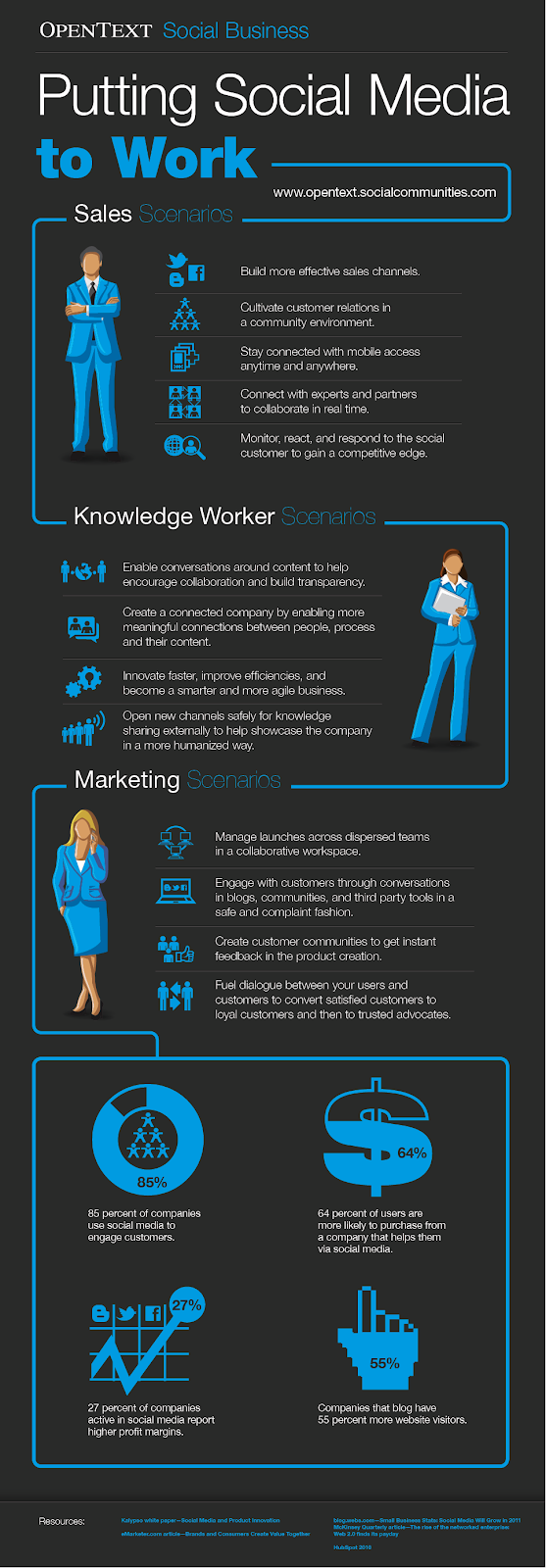
While often hard to measure, social business has productivity impacts that can be felt by IT, Sales, HR and many other areas in the organization — see Infographic (reg required) — but the real impact, and where the ROI can be best shown, is the increased engagement your internal and external audiences have with the communications initiatives that you invest in.

The key to measuring this increased engagement is ensuring you have the right tools and strategies in place to help monitor, react and respond to these initiatives in real time.

By analyzing real-time visitor and social interaction information (both inside and outside the firewall), organizations can help to optimize online initiatives and identify actionable trends within their visitor base, and capture user events that are specific to business goals.

The Impact of Social Analytics

The power in using Social Analytics is enabling the business to use the data to make recommendations to the business about how things are working, or not, and how they can be improved upon, both for your users and your customers.

Social analytics, from an external view, provides a window into things like how people perceive your brand and how they are responding to your corporate products, services, and marketing messages.

Internally, social analytics provides a window into things like; what is the most engaging content on my intranet; how many people are commenting on our blogs; what the tone of those comments are and who the most influential people in my community are.

Social Analytics can become the vehicle that helps your business translate data into insights. It can help improve your customer experience by writing better targeted content, can provide sentiment analysis, create higher converting sites and reshape a user’s site navigation to improve the overall online experience — just to name a few!

For a concise summary of cross-department benefits, download the Infographic here.


Wednesday, November 23, 2011

The Path to Social Business..Share, Engage and Measure


I spent the last week fully immersed at our user conference (OpenText Content World 2011) and in my opinion; I think it may have been our best conference to date. Each year I like to create a post after the conference that speaks to my experiences at the event and this year I thought it would be interesting to take a look back at a previous post I wrote in 2009 on social media and it's use and acceptance at the conference, just to see how far we have come in the last 2 years. As with the past years, I went to the conference to present on the topic of social business and the value of applying social media across the organization to help improve the customer experience. In 2009 I wrote in my post;
There was a general consensus with the attendees in my sessions that it was not a question of whether or not they saw the need to introduce more “social” tools to their users to allow them to contribute and build out conversations around content and business processes - the struggle existed in the ability to shift the mindset of users. Many people in the room were more concerned about how they were going to be able to adapt to the use of social media. They understood that this was more than just introducing new tool sets; it represented a culture shift - a shift that needs to happen to make the use of these social tools take on meaning and relevancy in their organizations.
I would have to say that this year I heard less about adoption issues, (though this is still a concern for many) as our customers seem to be on the path of understanding how they can apply social media to their current business processes to help knowledge share and better engage with each other and their customers. Many of the conversations that I had with our customers revolved around the ability to ensure that they can measure the effectiveness of their use of social media in the Enterprise. Customers were very interested in seeing where we are heading with our web and social analytics offerings as well as compliance; many of our customers are asking about how they can best balance the risks vs. the rewards when it comes to using social media in the Enterprise in an effective and safe manner. There were many discussions around the governance of social content and how customers can evolve their current knowledge management strategies to also now include social content.

It was nice to see this progression in the conversation around social media. The conversation is no longer just about the "why social media", we have progressed to the "how social media" and now we are starting to hear "how can we do better social media".

Where are you in your path to social business? Let's keep the conversations moving....

Monday, October 17, 2011

Social Buiness: It's Time to Put Social Media to Work!

Over the last 4 years in my role of product marketing for our social media and collaboration offerings we have used several terms to talk about social media such as; Web 2.0, Web 3.0, Social Media, Enterprise 2.0 and the Social Enterprise. The most recent term that has evolved is Social Business and, in my mind, this term resonates very well with the enterprise audience. Social business is about the shift in the way we do business and the changes in the business model itself. It's about tearing down the walls and the operational silos, it’s about connecting users, partners and customers through purposeful conversation and collaboration and most importantly, it’s about integrating or weaving social media into our existing business functions to help build a more collaborative infrastructure.

We seem to slowly be moving past the roadblocks and the misconceptions that have existed previously with the term, Social Media - many believed (and many still do) that social media in the enterprise resulted in time wasting and increased risk. Social Media made sense when we talked about it in the context of marketing, but when it came to applying social media within our day to day work stream it seemed harder to grasp where the value add would come from.

Over time, we are seeing many great use cases of value add when we apply the use of social features in the context of a existing business process; such as the on-boarding of new employees by offering them more transparency to the companies goals; empowering sales teams with collaborative team spaces to better learn from each other; fueling conversations with customers for improved marketing effectiveness, and many others.

My advice is start small, think about an area of your business that could benefit from increased levels of engagement. "Situating social media in high intensity areas of worker engagement and putting it in the flow of work is much more likely to result in substantial return on investment than large, horizontal deployments." wrote ZDNet's Dion Hinchcliffe.

Are you ready to put Social Media to work?